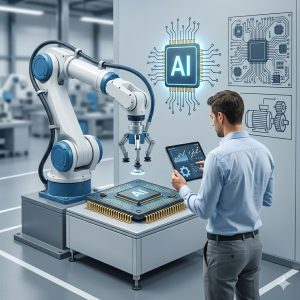
 Artificial Intelligence in Industry represents a strategic and practical guide dedicated to industrial leaders who wish to transition from traditional management methods to a data-driven smart factory. The program is not limited to presenting technologies; it offers a clear methodology for integrating digital solutions into the existing workflow, emphasizing pragmatism and operational efficiency.
Essential Information
- Duration: 2 days
- Recommended participants: 5-15
- Level: Intermediate / Industria
Target Audience:
- Production managers and process engineers who want to optimize their processes.
- Quality and maintenance specialists interested in predictive solutions.
- IT managers and digital transformation leads (Industry 4.0).
- Team leaders who want to reduce human errors and digitalize technical know-how.
- Entrepreneurs and Consultants.
- Employees interested in professional development.
Learning Objectives
At the end of the training, participants will be able to:
- Understand the mathematical and logical foundations of AI to eliminate misconceptions.
- Recognize how machines “see” (Computer Vision), “learn” (Machine Learning), and “reason.”
- Understand what AI, Machine Learning, and Computer Vision represent in an industrial context.
- Evaluate real benefits: cost reduction, defect prevention, and safety improvement.
- Use digital assistants (such as ChatGPT / Gemini) for daily engineering tasks.
- Become valuable members of internal teams planning to implement AI solutions within their own company.
Course Structure
Module 1 (Day 1): Foundation and Technology
- Introduction to AI: What AI is and what it is not (Demystifying concepts).
- The Foundation of Success: Why we must streamline the process before introducing AI. Eliminating waste and frustration through data preparation.
- Key Technologies in the Factory: o Machine Learning: Defect prediction and predictive maintenance. o Computer Vision: Automated quality inspection and safety monitoring (PPE). o NLP: Digitalization of technical manuals and voice assistants for operators.
Module 2 (Day 2): Implementation and Practice
- Steps for Implementing an AI Project: From data collection to model monitoring.
- Ecosystem Tools: Sensors, cloud platforms, and integration with existing systems (MES/ERP).
- AI in Your Pocket: Practical exercises with ChatGPT and Gemini for documentation optimization and solving technical problems.
- Case Studies: Analysis of successful implementations and lessons learned from failures.
- Personalized Roadmap: Scaling solutions and continuous innovation.
Organizational Benefits
- Alignment with Industry 4.0 Standards: Participants will be up to date with the latest Industry 4.0 practices, raising the expertise level of the entire department.
- Acquiring a Working Methodology: The course provides a clear implementation algorithm: Efficiency → Standardization → AI. Participants will learn how to prepare processes to eliminate team frustration and guarantee success.
- Reducing Resistance to Change: By understanding the role of AI as an “assistant” and not a “replacement,” participants become promoters of technology within the team, reducing colleagues’ anxiety regarding digitalization.
- Ability to Evaluate and Select Solution Providers: Participants will learn the technical language necessary to have informed discussions with IT departments or external providers, being able to define clear requirements and verify technical promises.
Please contact us for further information or personalized offers.
Contact
- 📧 Email: george@sanconsulting.ro
- 📞 Phone: +40 723093515
- 🌐 Web: sanconsulting.ro/contact