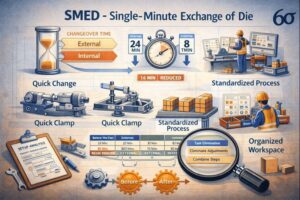
SMED represents a method for rapid changeover management, developed to reduce the time required to change equipment or tools within a production process. This method is often associated with the Lean production system and was designed to allow rapid and efficient adaptation of production to market demands.
The basic principle of SMED is to transform as many changeover steps as possible into “external” activities (performed while the machine is running) and to simplify “internal” activities. The main objective is to achieve a changeover time expressed in a single digit (under 10 minutes).
Essential Information
- Duration: 3 hours (usually coupled with other Lean Manufacturing courses)
- Recommended participants: 5-10
- Level: Introductory / Process Optimization
Target Audience:
- Quality specialists and process professionals.
- Production Managers and Directors.
- Professionals from various fields (production, logistics, etc.).
- Entrepreneurs and Consultants.
- Employees interested in reducing downtime and increasing flexibility.
Learning Objectives
At the end of the training, participants will be able to:
- Understand the key concepts related to changeover activities (identification and classification).
- Make a clear distinction between internal and external activities.
- Use complementary tools and techniques (5S, Poka Yoke, Standardization).
- Develop action plans for implementing SMED in their own departments.
- Apply the concept of Lot Size Reduction.
Course Structure
- Introduction to SMED: Definition, history, and objectives.
- Implementation Stages: Analyzing the current situation and separating activities.
- Optimization Techniques: Converting internal activities to external and simplifying adjustments.
- Monitoring: Evaluating results and reporting performance indicators.
- Case Study: Practical example of SMED implementation.
Organizational Benefits
- Reduced Changeover Times: Significant decrease in machine downtime periods.
- Increased Flexibility: The ability to switch rapidly between different types of products.
- Cost Reduction: Reducing inventories and time waste.
- Elimination of Non-Value: Identifying and eliminating activities that do not add value.
- Increased Quality: Standardized adjustment processes that reduce the risk of errors at startup.
The course will conclude with a multiple-choice examination, and participation statements or graduation certificates will be issued, as applicable.
Contact
Please contact us for further information or personalized offers.
- 📧 Email: george@sanconsulting.ro
- 📞 Phone: +40 723093515
- 🌐 Web: sanconsulting.ro/contact